
Jewelry manufacturing guide
3D Printing Jewelry: From CAD Design to Casting
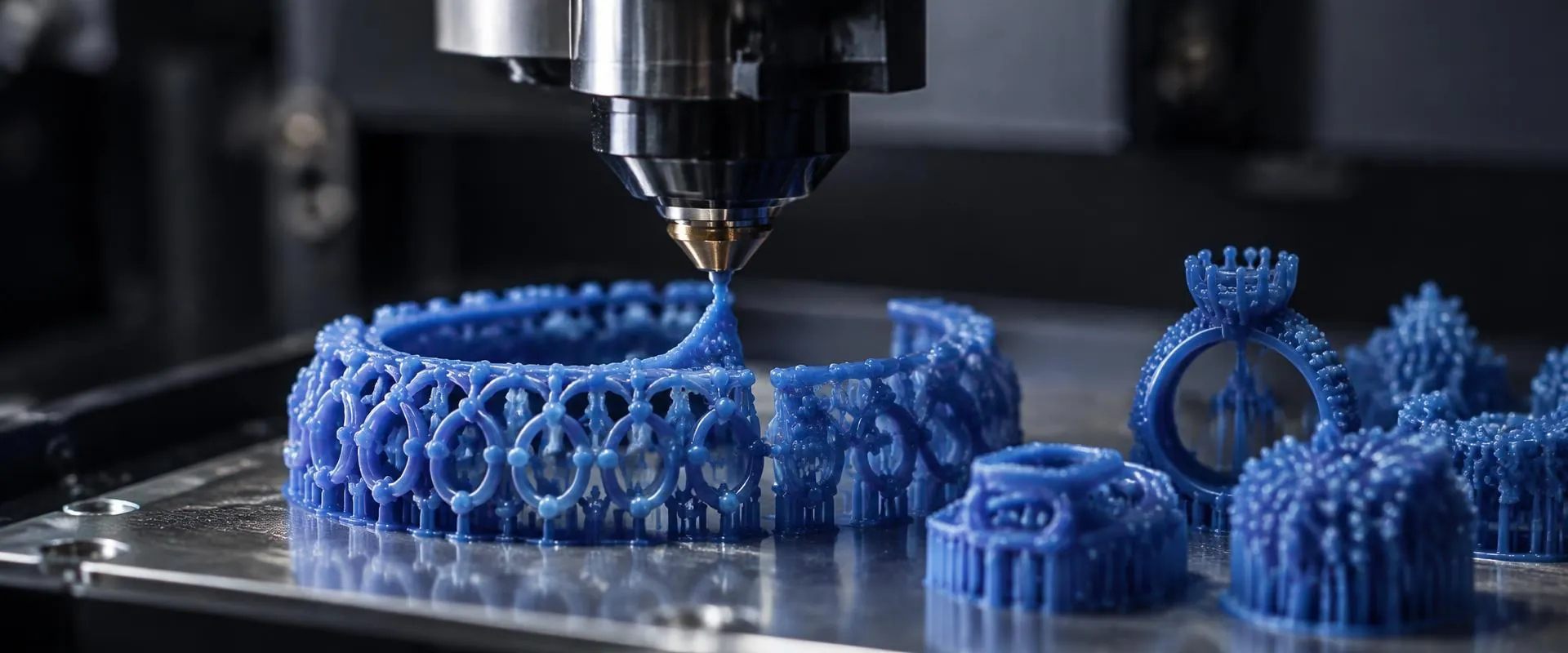
Jewelry 3D printing turns a digital design into either a castable pattern or a metal part. For most jewelers, the key decision is not simply which printer to buy—it is which complete workflow best fits the detail, volume, casting process, and finishing capacity of the shop.
The process
How jewelry 3D printing works
In a casting workflow, the printer does not usually make the final ring, pendant, or setting. It makes an accurate sacrificial pattern from the CAD file. That pattern enters the established investment-casting process in place of a hand-carved or molded wax.
- 01
Create the CAD model
Build the piece at finished scale, accounting for minimum feature sizes, stone settings, wall thickness, and any shrinkage expected in your casting process.
- 02
Prepare the print
Check the file for closed geometry, choose an orientation, and generate supports. Orientation affects surface finish, support placement, and production time.
- 03
Print the pattern
Produce a sacrificial wax or castable-resin pattern. For direct metal printing, the machine builds the final metal form instead of a casting pattern.
- 04
Remove supports
Clean the pattern according to its process. Solidscape systems print a separate Melt support wax that washes away without manually cutting supports from delicate features.
- 05
Invest and cast
Attach the pattern to a sprue, place it in investment, follow the material supplier’s burnout schedule, and cast the cavity in the chosen alloy.
- 06
Finish the piece
Remove the investment and sprues, then complete setting, assembly, polishing, and quality checks using the same bench skills as a traditional casting workflow.
Technology comparison
Wax, castable resin, or direct metal?
Each process solves a different production problem. Compare the output and all downstream steps—not resolution figures alone—before choosing a system.
| Technology | Printed output | Support removal | Casting path | Often considered for |
|---|---|---|---|---|
| Direct wax printing | Castable wax pattern | Separate support material can wash away | Melts at a lower temperature and burns out cleanly without ash | Fine jewelry, intricate patterns, short runs and repeat production |
| Castable resin printing | Photopolymer pattern | Usually clipped, filed, or sanded from the pattern | Needs higher-temperature, resin-specific burnout to remove photopolymers and limit ash | Prototyping and casting where resin workflow and material options are preferred |
| Direct metal printing | Finished metal form | Metal supports require mechanical removal | Bypasses pattern making and investment casting | Specialized geometries, production strategies, or alloys that justify a metal-printing workflow |
Always qualify a pattern material with its recommended investment and burnout schedule. Results also depend on geometry, spruing, flask preparation, casting equipment, alloy, and operator control.
Direct wax patterns
Why jewelers choose wax 3D printing
Purpose-built wax printing combines digital repeatability with a material class jewelry casters already understand. Solidscape’s Drop-on-Demand process deposits Midas build wax and Melt support wax through separate jets.
Compared with castable photopolymer resin, wax melts at a lower temperature and leaves no ash during a properly controlled burnout. Resin contains photopolymers and other ingredients that require a hotter, material-specific burnout and can leave ash when the cycle is incomplete. Directly deposited wax also preserves crisp surface detail without a separate UV-curing step.
Casting-oriented material
The output is a true wax pattern designed for investment casting. Its lower melting temperature and ash-free burnout avoid introducing cured photopolymers and other resin ingredients into the flask.
Wash-away supports
Melt support material uniformly holds fine details during printing and then washes away, reducing the need to clip supports from filigree, prongs, and small settings.
Complex, repeatable patterns
Digital files make it practical to reproduce custom pieces, variants, and short runs while preserving the geometry approved in CAD.
Product-process references: Solidscape Drop-on-Demand technology and Melt support material.
Planning
Choose the workflow around your shop
Independent designers
Start with the designs you produce most often. Consider outsourcing first if demand is occasional, then compare ownership when turnaround, confidentiality, or iteration speed becomes critical.
Casting houses and service bureaus
Prioritize predictable pattern preparation, repeatability, unattended support removal, batch planning, and the ability to process both one-off pieces and mixed customer orders.
Production teams
Evaluate throughput at the layer thickness and surface quality you will actually use. Include material handling, maintenance, post-processing labor, casting yield, and rework in the cost model.
Common questions about 3D printing jewelry
Can a 3D printer make finished jewelry?
It depends on the technology. Wax and castable-resin printers make sacrificial patterns that are investment cast in metal. Direct metal printers build metal parts, but those pieces still require support removal and finishing.
Why use wax patterns for jewelry casting?
Direct wax printing fits naturally into the familiar lost-wax process. The printed pattern is invested, removed during burnout, and replaced with molten metal. It is particularly useful when a design is too intricate or repetitive to carve efficiently by hand.
Is wax or castable resin better for jewelry?
For demanding lost-wax jewelry casting, direct wax has important advantages: it melts at a lower temperature, burns out without ash, needs no UV curing, and can preserve very fine printed detail. Castable resin can still suit some budgets and workflows, but its photopolymers require careful cleaning, curing, investment selection, and a hotter material-specific burnout to reduce ash and casting defects.
Bring printing in-house
Compare wax 3D printers
Explore systems for independent jewelers, custom workshops, and production environments.
Explore 3D printersPrint without equipment
Use our printing service
Send a CAD file for a cast-ready wax pattern before committing to an in-house workflow.
View printing services